The Tomoku Group recognizes the conservation of the global environment as an important social responsibility and is actively engaged in efforts to address global warming. As the impacts of climate change become increasingly severe, the Group is promoting reductions in greenhouse gas emissions from its business activities and the efficient use of energy to help realize a sustainable society.
Targets through 2030
Reduce greenhouse gas emissions (Scope 1 and 2) by 50% compared with 2013 levels
- Achieve a 100% share of electricity from renewable energy sources
- In the Housing Business (Sweden House Co., Ltd.), reduce primary energy consumption during occupancy by 50% on a CO₂-equivalent basis compared with Japan’s 2016 Energy Conservation Standards for Scope 3 Category 11, “Use of Sold Products”
To achieve these targets, the Group will continue its efforts to reduce environmental impact and pursue business activities in harmony with society.
Short- to Long-Term Initiatives
For Scope 1 emissions under the GHG Protocol, which covers direct greenhouse gas emissions from the Group, the Group will continue short-term measures that can already be implemented, such as electrifying on-site work lifts and improving truck fuel efficiency and vehicle utilization rates. Over the medium to long term, the Group will consider new investments, including switching boiler fuel from heavy oil to city gas at production sites where this has not yet been implemented, using biofuels, and taking into account the development and wider adoption of decarbonization technologies and infrastructure such as next-generation boilers and trucks powered by green hydrogen. For emissions that are difficult to reduce, the Group will also consider the use of carbon offsets through credits.
For Scope 2 emissions, which are indirect emissions arising from the purchase of energy such as electricity and heat, the Group will promote the transition to electricity from renewable energy sources by utilizing non-fossil certificates, on-site solar power generation, PPAs, and other measures.
For Scope 3 emissions, which are associated with the entire supply chain, the Group will strengthen engagement with business partners and expand the collection of primary data for Category 1 (Purchased Goods and Services). For Category 11 (Use of Sold Products), the Group will promote emissions reductions through the introduction of energy-efficient equipment, solar power generation, and other measures, in addition to the inherent high insulation and airtightness performance of Sweden House.
Introduction of Electricity Derived from Renewable Energy
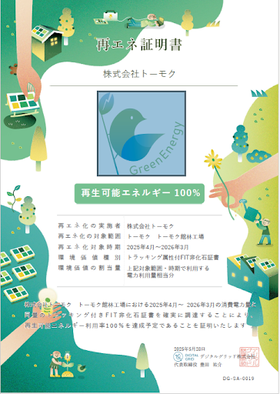 Example of a Non-Fossil Certificate for Electricity
(Tomoku Tatebayashi Works)
To reduce greenhouse gas emissions from electricity use, the Group applies FIT non-fossil certificates with tracking information. Non-fossil certificates certify the environmental value of electricity generated from non-fossil power sources that do not emit CO₂. The Group began using these certificates in FY2021, and in 2024 Tomoku achieved non-fossil sourcing for all electricity on a non-consolidated basis. This initiative is being expanded gradually to the Group’s major sites.
Boiler Fuel Conversion
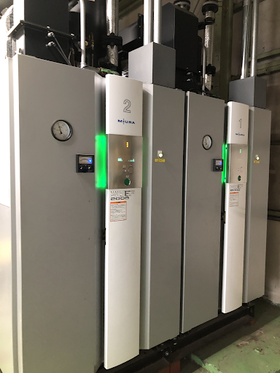 Example of Boiler Fuel Conversion
(A Heavy Oil to City Gas, Tomoku Hamamatsu Works)
The Group is promoting the conversion of boiler fuel from heavy oil to city gas at corrugated board production sites as opportunities arise to install main city gas pipelines nearby. Switching from heavy oil to city gas reduces greenhouse gas emissions while providing the same amount of energy.
Reducing Environmental Impact through the Introduction of EV and Hybrid Trucks
As part of its efforts to help build a sustainable society, Tohun introduced EV trucks in February 2022 and began operating them in Kanagawa Prefecture. Tohun has also introduced hybrid trucks. These initiatives directly contribute to measures to address global warming, including reductions in CO₂ emissions, and clearly demonstrate the social responsibility Tohun is expected to fulfill as a logistics operator.