Corrugated Container and Display Corton Business
Corrugated Board: A Clean and Sustainable Packaging Material
Renewable Resources
Forests are continually renewed through the cycle of growing, harvesting, and replanting trees. The wood pulp used to produce paperboard is sourced exclusively from responsibly managed forests.
Effective Use of Forest Resources
Corrugated board makes effective use of valuable forest resources, including wood from thinning operations, small or irregularly shaped trees, residual wood left after boards and structural lumber have been produced, and reclaimed wood from buildings and other structures. By putting these resources to good use, corrugated board helps minimize wood waste.
Carbon Neutrality*
The trees used to produce the wood pulp that serves as the raw material for corrugated board absorb CO2 through photosynthesis as they grow. As a result, corrugated board is a clean packaging material that does not increase atmospheric CO2 levels, even when incinerated.
*The CO2 released when biomass, such as plants, is burned is the same CO2 that was absorbed from the atmosphere through photosynthesis during the plants’ growth. As a result, biomass is considered carbon neutral over its life cycle because it does not increase the overall amount of CO2 in the atmosphere. This characteristic is referred to as carbon neutrality.
Returns to Nature
Corrugated board is made from 100% renewable natural materials. Used corrugated board is typically recycled, but even if it is inadvertently left in the environment, it will eventually decompose and return to the soil.
Corrugated Board: A Recycling Success Story in the Circular Economy
High Recycling and Recovered Paper Utilization Rates
Thanks to its exceptionally high recycling rate, corrugated board is often regarded as one of the most successful examples of recycling. More than 95% of corrugated board used in the marketplace is recovered. Recovered corrugated board is then recycled into paper raw material and used to produce new corrugated board. More than 90% of the raw material used to manufacture new corrugated board comes from old corrugated containers (OCC). As a result, corrugated board is one of the resources with the most well-established recycling systems.
Corrugated Board Recovery Rate (%)
Corrugated board recovery rate = [A] Net recovery volume of old corrugated containers (OCC) ÷ ([B] Containerboard consumption + [C] Net imports/exports of packaged goods)
[A] Calculated by excluding the weight of other recovered paper grades, foreign materials, and adhesive attached to recovered OCC.
[B] Containerboard consumption at corrugated board manufacturing plants.
[C] Estimated net quantity of corrugated board used to package imported and exported goods.
Source: Japan Corrugated Case Association (JCCA)
Corrugated Board Recycling Flow
Low Environmental Impact in the Recycling Process
As a paper-based material, corrugated board can be easily recycled simply by mixing it with water, which separates it back into fibers and allows it to be used again as a raw material for paper. This simple recycling process has a low environmental impact, making corrugated board an environmentally friendly packaging material.
Promoting the Use of the Corrugated Board Recycling Mark
Recycling Mark Display Rate (%)
Promoting Resource Reduction
Material Reduction and Average Basis Weight (%)
(Industry average figures are based on data published by the Japan Corrugated Case Association.)
- Average basis weight: The amount of containerboard used per square meter of corrugated board.
- Trends based on an index of 100 for the average basis weight in 2004.
Housing Business
Energy-Efficient, Comfortable Homes
Sweden House Environmental Policy
Inspired by Sweden’s philosophy of sustainable living, Sweden House promotes the construction of homes that showcase the warmth and beauty of natural wood, pursue energy efficiency and comfort, extend the functional life and long-term value of homes, and harmonize with Japan’s climate and culture.
Through these efforts, we strive to minimize household energy consumption, make effective use of clean energy, promote long-term carbon storage, conserve resources, reduce and reuse waste, respect biodiversity, and contribute to environmental conservation in local communities and around the world.
About Sweden House
- We continuously pursue improvements to build homes with an even lower environmental impact in response to technological advances and changes in the environment.
- We regard compliance with environmental laws and regulations as the minimum standard. In addition, we establish more stringent voluntary standards to further promote environmental conservation.
- By providing environmentally friendly homes, we eliminate waste across all aspects of our business and promote efficient resource use.
- We have established a timber procurement policy to support sustainable forest management and protect biodiversity.
- We provide ongoing environmental education for all employees to raise environmental awareness, while also encouraging our construction partners and other business partners to understand and support our environmental policy.
Building Homes the Sweden House Way
Sweden House Creates Comfortable Homes for People and the Planet
At Sweden House, we believe that caring for the global environment must go hand in hand with protecting people’s health and safety. Our vision of comfort lies at the intersection of these two values: creating homes that are kind to both people and the planet.
Sweden House Windows Reduce CO2 Emissions
Significantly Reducing Heat Gain and Heat Loss Through Windows
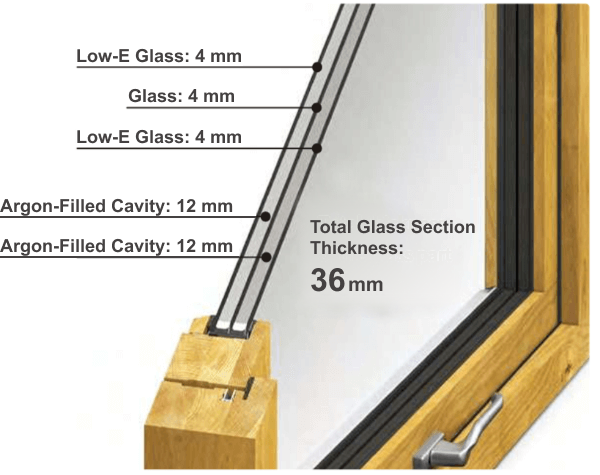
Since its founding, Sweden House has equipped every home as standard with triple-glazed windows featuring wooden sashes. This is because achieving high thermal insulation requires not only a well-insulated building structure but also highly insulated openings such as windows and entrance doors.
We are particularly committed to wooden window sashes because wood provides approximately 1,700 times the thermal insulation performance of aluminum. It also naturally regulates humidity, making it an ideal material for Japan’s hot, humid climate. Combined with triple glazing, these windows deliver even greater thermal insulation performance.
The cavities between the panes are filled with argon gas, which provides excellent thermal insulation. Whereas conventional double-glazed windows have a single 6 mm cavity, Sweden House windows feature two 12 mm argon-filled cavities—one on each side of the center pane—for a combined cavity width of 24 mm. The glass itself is also thicker, at 4 mm compared with the typical 3 mm used in double glazing. In addition, Low-E glass is standard on both the exterior and interior panes, reducing summer solar heat gain by approximately 50% while blocking about 78% of harmful ultraviolet rays.
Reducing CO2 Emissions by the Equivalent of 33 Beech Trees per Home
How much difference do Sweden House’s wooden-sash triple-glazed windows make compared with conventional aluminum-sash single-glazed windows? We estimated the reduction in CO₂ emissions achieved through the windows’ superior thermal insulation performance.
Focusing solely on the thermal insulation performance of the windows, each Sweden House home reduces CO₂ emissions by an amount equivalent to the annual CO₂ absorption of approximately 33 beech trees. Based on the approximately 34,307 Sweden House homes built nationwide as of the end of March 2019, this is equivalent to the annual CO₂ absorption of approximately 1.13 million beech trees.
Comfortable, Energy-Efficient Living—Simply by Living Normally
Comfortable Living with Approximately 40% Less Energy
In recent years, the energy efficiency of heating and cooling equipment has improved dramatically. However, if a home has poor thermal insulation, even the latest high-efficiency systems require significant energy to maintain a comfortable indoor environment.
Sweden House delivers outstanding energy performance as a standard feature through:
- Thick insulation that envelops the entire home
- Triple-glazed windows with wooden sashes
- Highly airtight construction
Together, these features minimize the effects of outdoor heat and cold while maintaining stable temperatures throughout the home, creating a comfortable, energy-efficient living environment.
Compared with a conventional home, indexed at 100% for primary energy consumption*, a Sweden House enables comfortable living while using approximately 40% less energy (see figure).
- Total energy consumed by the entire building.
Sweden House Meets ZEH+ Performance Standards with Its Standard Specifications
Going Beyond Net-Zero Energy Homes
As Japan pursues the realization of a low-carbon society, the government is promoting energy-efficient, low-carbon housing to reduce energy consumption and CO₂ emissions in the residential sector. Key benchmarks in this effort are Net Zero Energy House (ZEH) and Life Cycle Carbon Minus (LCCM) housing (see figure).
Achieving Net Zero Energy House (ZEH) standards requires three key elements:
- A highly insulated building envelope
- High-efficiency energy-saving equipment
- Renewable energy systems, such as solar photovoltaic systems
With its highly airtight, highly insulated construction, Sweden House comfortably meets the ZEH insulation standard (UA value of 0.60 for Japan’s Climate Zones 4–7) with its standard specifications (average UA value of 0.38 in fiscal 2018). As a result, it substantially reduces energy consumption, enabling annual net-zero energy performance with a relatively small photovoltaic system.
The Japanese government’s long-term goal is the widespread adoption of Life Cycle Carbon Minus (LCCM) housing, which reduces CO₂ emissions throughout a home’s entire life cycle—from construction through demolition—to achieve a net-negative lifetime carbon balance.
Because Sweden House homes are built with inherently high thermal insulation performance, they can also qualify for LCCM certification by combining high-efficiency energy-saving equipment with a photovoltaic system.
Since its founding in 1984, Sweden House has maintained the philosophy that a home’s fundamental performance is more important than relying solely on equipment. Accordingly, every home has been built to a single high-specification standard. As a result, not only newly constructed homes but also existing Sweden House homes can achieve annual net-zero energy performance.
Image of the Transition Toward Low-Carbon Housing
Transportation and Logistics Business
Initiatives Aimed at Achieving the Highest Standards of Logistics Quality
Tohun Co., Ltd. is committed to further enhancing customer trust and satisfaction through rigorous compliance. The company is certified under ISO 9001 (Quality Management System), ISO 14001 (Environmental Management System), and OHSAS 18001 (Occupational Health and Safety Management System). In addition, its business sites have been certified under the G-Mark Safety Excellence Program.
For fleet management, all vehicles are equipped with GPS-enabled fleet management systems. Driving data collected through digital tachographs is used to monitor driving safety by tracking indicators such as rapid acceleration, sudden braking, maximum speed, continuous driving hours, and duty hours. At each logistics center, thorough alcohol screening and strict management of drivers’ working hours help eliminate drink driving and prevent fatigue-related driving.
From an environmental perspective, Tohun works to prevent environmental degradation and promote environmental conservation through more efficient logistics operations, eco-driving practices, reduced idling, the replacement of vehicles with models that comply with the latest emissions standards, and the introduction of hybrid vehicles.
In addition, Tohun aims to achieve zero workplace accidents by planning and implementing occupational health and safety initiatives tailored to its actual operating conditions. The company works to improve occupational health and safety standards, prevent work-related injuries and illnesses, and maintain a comfortable working environment.
To further enhance quality and safety awareness, Tohun develops highly skilled logistics professionals and supports the establishment of a strong safety culture through the training of internal auditors, accident prevention education, the use of driving record certificates, and the acquisition of professional qualifications.
Through appropriate operations management and comprehensive safety education, Tohun aims to ensure the continued delivery of safe, reliable, and dependable transportation services while meeting increasingly sophisticated and diverse customer needs.