As the importance of environmental considerations in corporate activities continues to grow, biodiversity conservation is drawing increasing attention as an essential element in realizing a sustainable society.
For companies, biodiversity loss can increase risks to business continuity by destabilizing the supply of raw materials, accelerating climate change, and damaging relationships with local communities. The Tomoku Group will fulfill its social responsibility and achieve long-term corporate growth by accurately understanding the impact of its business activities on the natural environment and by striving to balance sustainable resource use with ecosystem conservation.
Initiatives Toward 100% Sustainable Raw Materials
Purchase of FSC-Certified Containerboard
In accordance with its Sustainable Timber and Paper Procurement Guidelines, the Company’s Corrugated Container and Display Carton Business uses containerboard made primarily from recovered paper collected from the market as a recycled resource. At the same time, containerboard contains some virgin pulp, and in some cases, its place of origin cannot be accurately traced. For this reason, the Company is actively promoting the purchase of FSC®-certified containerboard to more reliably ensure the sustainability of its raw materials. By using FSCFSC® certification, the Company can confirm that the raw materials it uses are derived from responsibly managed forest resources, even when their place of origin cannot be accurately traced.
Note:
FSC certification is an international certification system operated by the Forest Stewardship Council that verifies sustainable forest management. It
certifies that wood and paper are sourced from forests managed with due consideration for environmental, social, and economic factors. CoC certification, or Chain of Custody certification, is a system that enables products to be traced back to FSC-certified forest sources.
Housing Timber Procurement with Consideration for Forest Resource Conservation
In the Housing Business (Sweden House Co., Ltd.), land development and timber procurement can significantly impact the natural environment, making it essential to design and build with due consideration for local ecosystems and wildlife habitats. Through the use of sustainable timber, the conservation and creation of green spaces, and community development in harmony with nature, Sweden House aims to conserve biodiversity and coexist with local communities. In accordance with its Wood Procurement Policy, Sweden House supports sustainable forest management and is actively engaged in biodiversity conservation.
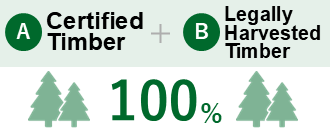
Categories of Timber Used
(for Structural Materials in Main Building Components)
| Category |
Description |
Ratio |
| A |
Certified timber or timber made from certified raw materials |
88.2% |
| B |
Timber legally harvested in accordance with forest harvesting laws and regulations in the country of origin |
11.8% |
| C |
Timber for which the legality of harvesting cannot be confirmed |
0% |
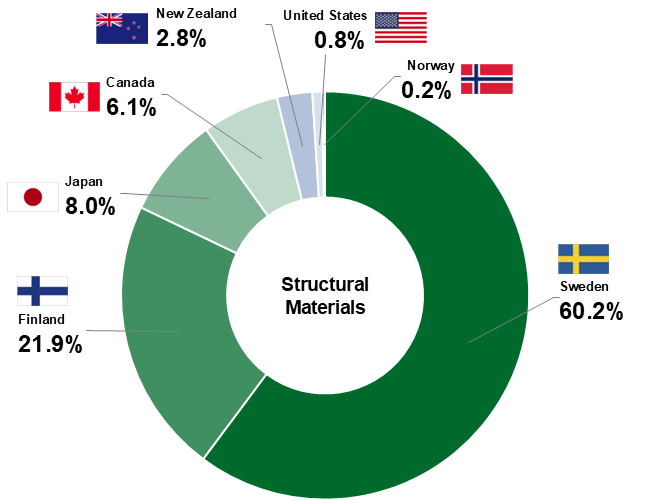
Procurement Sources by Country
Supply Chain Management
Implementation of Self-Assessment Questionnaires (SAQs) for business partners covering legal compliance, environmental issues, human rights, and other matters
In FY2024, SAQs were conducted for all suppliers of raw materials for corrugated board.
Initiatives Aimed at High Quality Control, Waste Reduction, and Safety in the Housing Business
Reducing waste and improving safety through precutting and larger panels
Components transported from Sweden are stocked in warehouses and precut centers in Japan. To improve work efficiency at construction sites and reduce waste, materials are precut and made into panels for floors and walls. When delivering components to construction sites, the Company thoroughly minimizes spare materials by ensuring that no excess components are delivered to the site.
In addition, the Company is implementing full panelization of exterior walls (Photo 1), larger interior wall panels (Photo 2), and second-floor panels with plywood attached (Photo 3),with the aim of further reducing waste, shortening construction periods, and improving safety. Panelizing non-standard exterior walls in Japan and adopting larger interior wall panels of up to 4.2 meters help reduce waste while also contributing to shorter construction periods and lower costs.
Previously, plywood was attached to second-floor panels at construction sites. By delivering floor panels with plywood already attached, work efficiency is improved and fall-related accidents can also be prevented. Through these measures, the Company is creating a safe and secure working environment for people at construction sites.
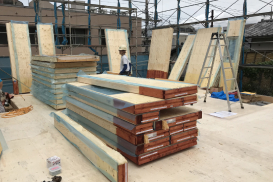 Full panelization of exterior walls at plants in Japan (Photo 1)
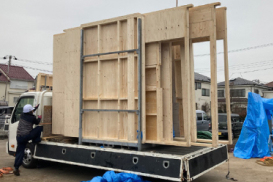 Larger interior wall panels (Photo 2)
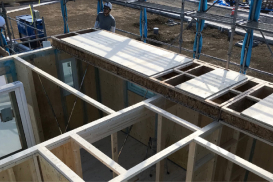 Use of floor panels with plywood attached for second floors to prevent fall-related accidents (Photo 3)
High-Performance Homes That Deliver Long-Term Comfort Are Built on Thorough Construction Site Practices
The high level of residential performance offered by Sweden House homes, including superior airtightness and insulation, depends on the technical capabilities of construction site personnel and an environment in which those capabilities can be fully demonstrated. To support this, Sweden House implements 5S-based construction-site practices. The Sweden House 5S Handbook, which brings together measures for maintaining clean, well-organized construction sites through the habitual practice of sorting and organizing, reducing waste, and ensuring worker safety, is distributed to all employees and partner contractors working on construction sites to promote a thorough understanding and implementation.
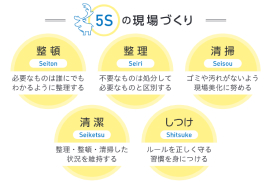
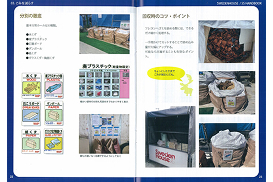 Sweden House 5S Handbook,
which summarizes 5S-based construction site practices